
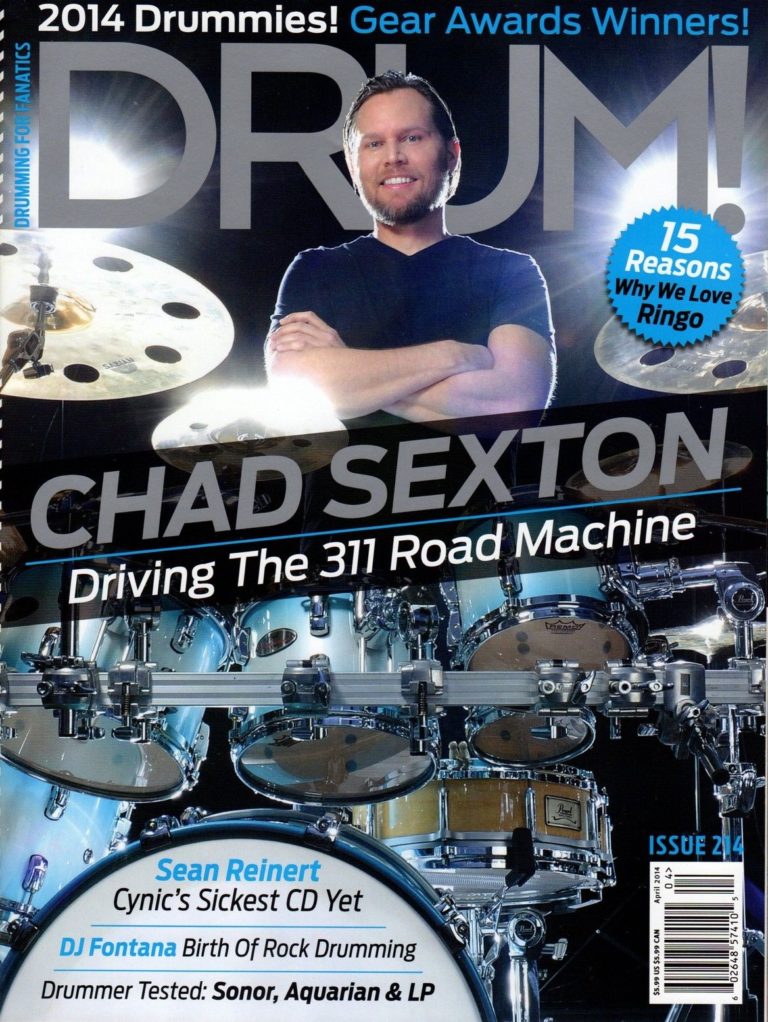

It’s always sunny in 311-land. While a great deal of the United States endures the year’s first notable winter storm – life-threatening subzero temperatures in the Midwest; two feet of snow in the Northeast; and more than 10,000 flights impacted across the country – Chad Sexton is relaxing on the grounds of his estate in Fillmore, California, where the temperature is a balmy 74 degrees and the avocado trees are far from dead.
Sexton and his four bandmates are originally from Omaha, Nebraska, and spent their early years cutting tracks a few miles from the swaying cornfields that define the region’s economy. But the almost 26-year-old group – widely known for its signature mix of rap, rock, and reggae, and the string of popular singles that helped define so-called “modern rock” through the ’90s and early 2000s – is strongly identified with the Golden State. There’s something about the band’s multi-part harmonies, crunchy guitars, and hop-step tempo that evokes sunnier climes. (Or maybe it was just the peroxide blond look some of the guys adopted in the ’90s.)
Indeed, Sexton has been living in California since 1992, years before the band skyrocketed to post-grunge prominence. For many years he called busy Los Angeles home, but in 2008 sought a bigger plot of land and a more calming environment. (Yes, you read that right: a rock drummer whose playing volume regularly approaches the threshold for human pain wanted a little peace and quiet.) Fillmore fit the bill.
“Fillmore’s probably 45 minutes to an hour outside of Hollywood. There’s a valley, but then there are small mountain ranges on the north and south sides of it. It’s really beautiful California land – real peaceful. It’s been a fantastic change. More space, less people, less noise.”
And more time to focus. Sexton and his bandmates spent much of 2013 hard at work on their latest full-length album, Stereolithic. It’s the band’s eleventh since their 1993 major label debut, Music, and a return to working with producer Scott Ralston, who handled production duties on many of the band’s most popular albums.
“We sort of got our old team back together – musically, production-wise. We wanted to get back to what we know we do. We’re all older; lots of changes have taken place. We wanted to pull out some of the essence of what the band has built: the styles, the tones. Scott has probably assisted on most records we’ve done. We decided, ’Hey, why don’t we team up with Scott again and see what happens?’ It’s great because he knows us really well. He knows our style really well. Working with him, we were able to pull out a good amount of material.”
Enough for 15 final tracks, in fact. The styles of the songs reflect the band’s sonic diversity over the years: “Five Of Everything” could easily be played back-to-back with 1999’s bouncy “Come Original” without the listener noticing the 15-year gap between them; the thrashy “Existential Hero” can hang with 1995’s “Down” any day of the week. It’s not all a retread, either: “Showdown” begins as a full-on, four-to-the-floor rocker before ceding to a reggae groove; “The Call” could be a late-era Thrice track if it were more ponderous and reverb-heavy.
For Sexton’s drumming, Stereolithic represents a return to a comfortable center after a string of records in which he sought to broaden his tonal horizons with less familiar producers. In 1996, Sexton told this very magazine that Dennis Chambers, Vinnie Colaiuta, Dave Weckl, and Terry Bozzio were early influences. Though he retains his taste for fusion drumming, Sexton was looking for something more visceral as he entered the studio.
“We just came off a couple of records of trying out new ideas, different ways of playing, different styles. For me, that might be different fills, or different simplified patterns. That was good – it’s showing me and teaching me something I’m not naturally coming up with and getting input from a professional like Bob Rock on things I should try. Now, we’re trying to be us again. But it’s different – you’re taking the new things and incorporating them into your drum writing.”
Sexton admits that he’s never been an obsessive drummer – he embraces formal technique, but doesn’t let the potential for complexity overwhelm his contribution to a song. On Stereolithic, Sexton still allowed himself to tweak his roadmaps and fills, but not too much. It’s reflective of the kind of player that Sexton, 43, has become as he navigates the middle stage of his career.
“I try not to overthink anything. Brains tend to destroy art, I believe. Putting too much intellect into art. I think about it just a little, to make it cohesive. That style has worked out for me and made me think I should think about my drum beats more. There’s something that’s real special about coming from a creative place that you’re keeping your intellect out of. This album, I’m trying to combine both those styles.”
Celebration Day
Stereolithic will officially debut on March 11, a date known better among devoted fans as “311 Day.” It’s no mere marketing trick. Every two years, the band arranges a single show aimed directly at its most hardcore fans, with a marathon set list that pushes each of 311’s five members to their very limit in the name of giving die-hard fans what they want. Previous 311 Day shows have stretched to more than seven hours, with some 70 songs – many extremely deep album cuts usually left off the set lists of normal shows – played in a single night.
“It’s an endurance test. My back feels like it will leap up off of my body and die somewhere. The last 311 Day was in Las Vegas, at the MGM Grand. There were maybe 12 to 15 thousand people. We actually played two nights. It was a little easier at 40 songs a night, no repeats.”
This year’s show is special because it’s a return to New Orleans, where 311 Day was first held in 2000. That year, the band played 47 songs. This year, Sexton and company need to top the 79 songs they played in 2012. They’re excited to bring the party to the New Orleans Arena, which can hold more than 19,000 people and is located mere blocks from the city’s famed French Quarter.
“New Orleans is the perfect place to have it. They have Bourbon Street and people can hang out and have a place to hang out. It’s hard to hang out and drink on the Strip in Vegas. We’re getting geared up for that.”
This year also marks the first time that the band will release a new album on 311 Day – a surprise, considering how long the band has kept up the tradition. The decision means that Sexton and company have a series of new songs to master on top of relearning its more obscure songs, all in preparation for fans with encyclopedic knowledge of the 311 discography. The challenge is more daunting than ever.
“At this point, 311 has maybe 130 songs in the catalog. So we have to practice and recall these deep cuts. We don’t want to repeat things we did on the last 311 Day, or even before that. So we look at those set lists and come up with a new list – of course, incorporating new songs. It’s a pretty intensive thing. Everyone has pretty big rigs at this point – we’ve been making music since ’92, so you have a lot of different tones and sounds that you have to recreate. That’s a challenge for me. I’ve developed as a musician; I’ve changed. To pull out something from 1994, I might have to pull out a snare to make the song sound like it was originally presented.”
Luckily, Sexton can take advantage of a recording studio in North Hollywood called The Hive, which the band purchased a decade ago. It’s where most of its recent albums were recorded and where the band will be vigorously rehearsing in anticipation of 311 Day. For Sexton in particular, that means building muscle and toughening calluses to handle the extreme physical demands of such a gig – one that, one year, put him in the hospital for dehydration.
“I’m both a technical and emotional player. I try to walk the balance beam. I’m not one to sit down and practice a lot – it’s more concepts, and watching other guys play, and watching clinics. Just by watching, it changes my playing. I try to take in everything I can take in. I’m not a guy to go in the drum shed and play for hours.”
That’s a habit left over from the River City Railmen and the Sky Ryders, two Midwestern drum corps that left an indelible impression on Sexton’s early style. The regimented approach to playing for a corps gave Sexton his love for a snappy snare drum and instilled in him a professional, show-up-ready attitude that will come in handy in March.
“I marched drum corps for five years when I was younger. My technique has stayed with me after five years of eight hours a day. So I rely on my technicality. For me, that training has been nothing but good. I’ve been able to carve out my own niche and style and snare tone from it. That’s how I’m putting my beats together – it’s drum corps-based. It’s not just snare rolls, but drum placement. That’s the one thing that helped me carve out my own signature sound.”
In It For The Long Haul
Like many bands with a distinct sound, 311 has always had difficulty fitting into a clear category. Is it a rock band? Is it “ska,” “alternative,” or something else? What about the reggae and ambient leanings? The answers to those questions have changed over 311’s multi-decade career. The band easily could have remained a ’90s footnote when its eponymous album rocketed to triple platinum status; instead, the band kept dependably recording and touring, evolving into a comfortable, fan-focused act – much like peers Pearl Jam and the Red Hot Chili Peppers – that is known better for being itself than assuming the mantle of a specific genre of music.
When I asked Sexton what he thought the state of rock is in 2014 – a time when rock radio has clearly ceded its cultural dominance to hip hop – he paused and pursed his lips in thought.
“Rock is … I don’t know. It’s definitely always changing. Rock, for me right now, can be represented by two bands: The Deftones, and a band called Down – Phil Anselmo’s band. We definitely dive into rock, but that doesn’t define our band. We have plenty of hardcore full on rap-rock songs, full bore, on the new record. But we also play reggae slow songs. You can’t really call that rock. We consider ourselves a rock band, first and foremost. To me, rock is kind of about the tempo, the tones, and how the guys are approaching it. There are a lot of electronics involved in certain rock bands now.
“Where rock hit its stride in the late ’60s and ’70s – Black Sabbath, Led Zeppelin, Kiss, Jimi Hendrix – those guys are rock. Yes, it has changed. The first alternative music in this land was [from] bands like R.E.M. Then those bands became harder. It evolved to the time when we came into the picture, and No Doubt, and Red Hot Chili Peppers. Then it became ’modern rock.’ I kind of have a fear that the rock that you’re used to back then is kind of becoming extinct.”
That fact is hardly slowing 311 down. Beyond its big day in March, the band is preparing for a likely summer tour in support of Stereolithic. With rock radio fragmented into a million pieces, Sexton is looking elsewhere for drumming inspiration. The answer may surprise some of the band’s most dedicated fans.
“I listen to a lot of R&B and Top 40 radio – Kendrick Lamar and the other 18 songs they rotate – because I want to hear what someone else is doing. I know what rock is doing; I know what’s out there. It’s about taking in something that’s totally different, even things that don’t have a drum set, and hearing how it’s coming off and affecting the music and groove. I take all the songs in and somehow they influence me to write beats that are danceable.”
Wait a minute – 311 the dance-punk band, á la LCD Soundsystem or The Rapture? Not quite, Sexton insists. It’s all about channeling the slinky stroll of the drum machine on Lamar’s “Swimming Pools (Drank)” to encourage that head-bobbing reaction that 311 is known for in the context of its own sound.
“I’m always trying to think about how our hardcore fans will react to it. They’re very excitable, so I’m always working to make sure there are excitable elements in my drumming that will make them dance or jump around. I was really trying to be ’danceable rock’ for a lot of the songs on this record. I’d listen to Power 106 every time I went down to the studio: Jay-Z, Justin Timberlake, Rihanna. I pull myself out of my world and listen to that over and over.”
That doesn’t mean 311 will be backing Mr. Timberlake on a tour anytime soon, either. Twenty-six years in, the band knows what it can and can’t do, and won’t try to be something it isn’t. “Anytime you try to pull this band out of its element and try to make it become another band, it doesn’t seem to work. You don’t want to be closed off as a musician; you want to be open to new ideas and grow. Some of those ideas work, and sometimes it’s better to go to stuff naturally. We try to be the best 311 we can possibly be.”
The Thinker
When Sexton bought his home in Fillmore, it came with a surprise bonus: a garage large enough to fit an RV. Some musicians might look at such a structure as the perfect place to park the tour bus. The drummer had other ideas.
“I have a rig up here. Pro Tools HD, a lot of great mikes and mike pres. We’re able to come up with some nice, big, warm sounds that have quality to them.”
Lately, Sexton has been out there rehearsing on his own, in anticipation of the more formal rehearsal sessions ahead of 311 Day and the launch of Stereolithic. The alone time has allowed him to reflect on his playing over the years, and com- pare his latest playing with some of his earliest.
“If I run into a pattern that’s kind of busy on the bass drum, I remember that time period, and not once ever thinking about playing it. But now when I go back and look at it, I’m listening to it, I’m thinking about it, and wondering, what would make me do that? And the answer is – nothing! I never tried to put my brain into action back then. When I revisit it, it’s so funny. I’ll think, well, how high was I sitting when I played that? Because when I have to play that on the bass drum today, and I’m sitting too high, I kind of can’t power it out, even though it’s more comfortable for me to sit higher now. But back then, I never measured it! I never thought to. So I find myself even looking at old pictures to see how high my feet were or snare drum was.”
For a band with such an extensive discography, it is surprisingly important to be aware of paths already traveled. Sexton soberly recalls a special show in Boston in 2000 when the band played its popular self-titled album all the way through. The stylistic uniformity from song to song made Sexton realize that he needed to be more cognizant of his drumming and not let feel completely rule the day.
“I thought, ’Oh my God, almost all of these songs have the same drum beat.’ That’s when I thought, ’I should have put a little more intellect or thinking into what I was doing.’ No philosophy that you’re going to choose for your playing or your life is probably going to be the correct one for your entire life.”
So it has helped, then, to work with Ralston on Stereolithic. “Working on the new record with a guy that knows us so well, especially from the ’90s, he’d make that comment a lot: ’… like we used to do, back in the day.’ It’s just getting so many years at this point, when we think about what we should do, we don’t really have an answer. We just make records, play music, and you just try to do the best you can.”
Which is what Sexton will be doing in his RV-garage-turned-studio on the outskirts of Fillmore, late into the night during the warm winter months, as he prepares for what appears to be another banner year for 311.
“I’ve got a patient girlfriend. And I’m away from neighbors as well. Sometimes I’ll drum at 11:00 o’clock at night and it’s totally fine. I just lucked out that way. I didn’t really plan it.” He pauses for a moment, then laughs at himself. “Didn’t over-think that one, either.”
Sexton’s Setup
Drums Pearl Reference (Sea Foam custom finish)
1 22″ x 18″ Bass Drum
2 14″ x 5″ Pearl Free Floating Maple Snare
3 6″ x 6″ Tom
4 8″ x 7″ Tom
5 10″ x 8″ Tom
6 12″ x 8″ Tom
7 13″ x 9″ Tom
8 14″ x 14″ Floor Tom
9 16″ x 16″ Floor Tom
10 20″ x 14″ Gong Drum
11 6″ x 12″, 6″ x 15″, 6″ x 18″, 6″ x 21″ Rocket Toms
Cymbals Sabian A 19″ AAX O-Zone Crash
B 7″ Radia Nano Hats (mounted)
C 12″Chopper
D 18″ AAX O-Zone Crash
E 15″ Artisan Hats
F 10″ AAX Air Splash
G 20″ HHX Evolution O-Zone Crash
H 9″ AAX Max Splash
I 10″ O-Zone Splash
J 20″ HHX Evolution O-Zone Crash
K 22″ Artisan Raw Bell Ride
L 19″ Paragon Chinese
M 18″ HHX Evolution O-Zone Crash
N 18″ HHX Evolution Crash
Chad Sexton also uses Pearl hardware (including Icon rack system), Vater Chad Sexton signature sticks, and Remo heads.
Source: http://www.drummagazine.com/features/post/chad-sexton-let-it-be/
 311 Archive